
Calculate your ovulation date and fertile days
Cycle length: first day of period to next period. Luteal phase: ovulation to next period.
Your Fertility Calendar
Next Period
–
Ovulation Date
–
Fertile Window
–
Next Cycle Start
–
Your Cycle Overview
- Menstruation: – (approx. 3-7 days)
- Fertile Window: – (highest chance of pregnancy)
- Ovulation Day: – (most fertile day)
- Luteal Phase: – (post-ovulation period)
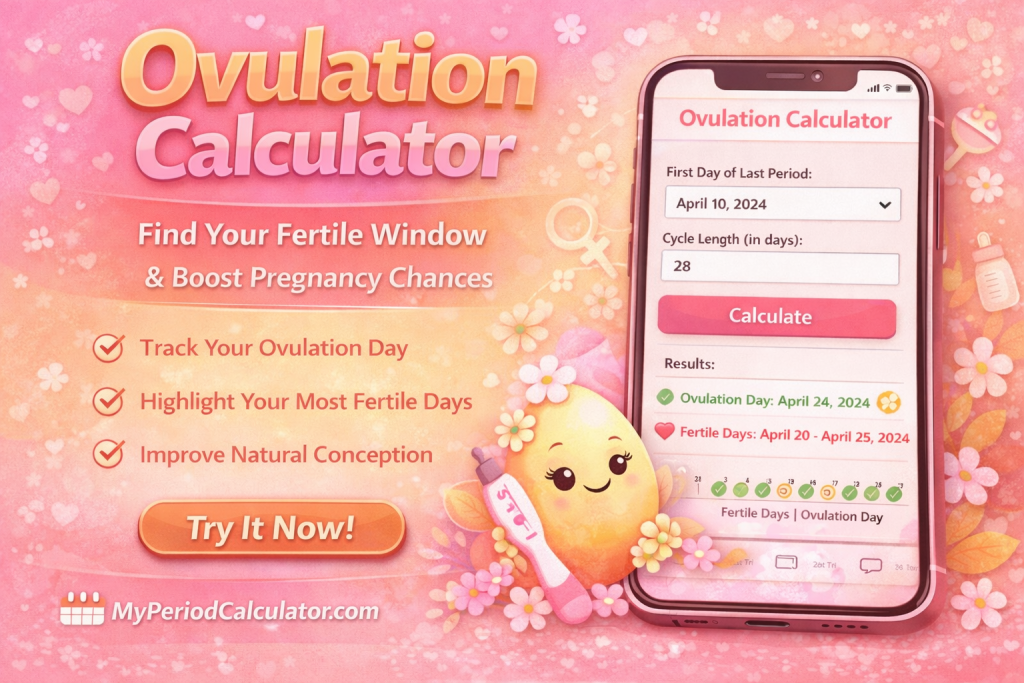
Are you trying to conceive and wondering when exactly your body is ready? Or maybe you just want to understand your cycle better? Our free ovulation calculator helps women in the US, India, and around the world pinpoint their exact ovulation date, fertile window, and peak conception days all in seconds, completely free.
How to Use the Ovulation Calculator Simple 3-Step Process
You don’t need to be a medical expert to use this tool. Just follow these three simple steps and you’ll have your results instantly.
Step 1 Enter the First Day of Your Last Period This is the very first day you noticed actual bleeding — not spotting or light discharge, but real menstrual flow. In medical terms, this is called the first day of your last menstrual period (LMP). This date is the foundation of all cycle calculations. If you’re not completely sure of the exact date, use your best estimate — even an approximate date will give you a helpful result.
Step 2 Enter Your Average Cycle Length Your cycle length is the number of days from the first day of one period to the day before your next period starts. Most women have cycles between 21 and 35 days long. The most commonly cited average is 28 days, but research shows that fewer than 15% of women actually have a perfect 28-day cycle. If you’ve been tracking your periods, count the days between your last two or three cycles and use that as your average. If you’re just starting out, 28 days is a safe default.
Step 3 Hit Calculate That’s it. Hit the calculate button and within seconds you’ll receive a complete breakdown of your most fertile days, including:
- Your exact ovulation date
- Your full fertile window every day when pregnancy is possible
- Your peak fertility days when chances of conception are highest
- Your next expected period date
- The best time to take a pregnancy test
What Is Ovulation? A Complete Explanation
Ovulation is one of the most important events in the female reproductive cycle. It is the moment when a mature egg also called an ovum is released from one of the ovaries and becomes available for fertilization by sperm.
Here is exactly what happens during ovulation, step by step:
The Brain Sends the Signal In the first half of the cycle, the pituitary gland in the brain releases a hormone called follicle-stimulating hormone (FSH). This hormone tells the ovaries to begin developing several follicles tiny fluid-filled sacs, each containing an immature egg.
One Follicle Becomes Dominant Over the course of 10 to 14 days, the follicles compete, and one becomes the dominant follicle. This dominant follicle grows larger and produces increasing amounts of estrogen.
The LH Surge Triggers Ovulation When estrogen levels reach a peak, the brain responds by releasing a large burst of luteinizing hormone (LH). This LH surge is the direct trigger for ovulation. Within 24 to 36 hours of the LH surge, the dominant follicle ruptures and releases the mature egg.
The Egg Travels to the Fallopian Tube The released egg is swept into the fallopian tube, where it begins its journey toward the uterus. The egg remains viable for fertilization for approximately 12 to 24 hours after being released.
Fertilization Window If sperm is present in the fallopian tube during this window, fertilization can occur. Because sperm can survive inside the female reproductive tract for up to 5 days, having intercourse in the days leading up to ovulation can also result in pregnancy which is why your fertile window is longer than just the day of ovulation itself.
If Fertilization Does Not Occur The egg dissolves and is absorbed by the body. Hormone levels shift, the uterine lining breaks down, and your period begins approximately 14 days after ovulation starting the cycle over again.
What Is a Fertile Window? Everything You Need to Know
Your fertile window is the stretch of days in your menstrual cycle when pregnancy is biologically possible. Understanding your fertile window is the single most important factor when you are trying to conceive.
Here is a precise breakdown of your fertile window:
5 Days Before Ovulation Sperm deposited in the reproductive tract up to 5 days before ovulation can survive and fertilize the egg once it is released. This means that intercourse several days before you actually ovulate can still result in pregnancy which surprises many people.
The Day Before Ovulation This is one of the two peak fertility days. Sperm deposited now will be fresh and ready when the egg is released the following day. Conception rates are highest on this day.
The Day of Ovulation This is the other peak fertility day. The egg is freshly released and at its most viable. Sperm that reach the egg within this window have the best chance of fertilization. Conception rates are highest on this day and the day before.
1 Day After Ovulation The egg remains viable for a short time after ovulation, so the day after ovulation is still technically within the fertile window, though conception rates drop significantly.
Outside the Fertile Window After the fertile window closes typically from Day 2 after ovulation until your next period pregnancy is very unlikely. This is because the egg is no longer viable and there is no new egg available until the next cycle.
In total, your fertile window spans approximately 6 days per cycle. The two days with the absolute highest chances of conception are the day before ovulation and the day of ovulation itself.
Ovulation Calculator for Indian Women What You Need to Know
In India, millions of women search for ovulation calculators every month — and for good reason. Awareness of menstrual health and fertility tracking is growing rapidly across the country, and more and more women are turning to online tools to understand their bodies.
Here are some things that are particularly relevant for women in India:
Average Cycle Length in Indian Women Research suggests that the average menstrual cycle length in Indian women is similar to the global average — typically between 28 and 30 days — though cycles between 21 and 35 days are all considered normal. If your cycle has always been slightly longer or shorter than the “standard” 28 days, that is completely fine. Enter your personal average cycle length into the calculator for the most accurate results.
Diet and Cycle Health A diet rich in iron, folic acid, and essential vitamins is important for regular ovulation and menstrual health. Iron-rich foods like spinach, lentils (dal), and legumes are excellent choices. If you are trying to conceive, doctors in India commonly recommend starting folic acid supplements at least one month before trying, as folic acid significantly reduces the risk of neural tube defects in the baby.
PCOS Is Very Common in India Polycystic Ovary Syndrome (PCOS) is one of the most common hormonal conditions among women of reproductive age in India, with some studies suggesting it affects up to 20% of Indian women — a higher rate than the global average. PCOS often causes irregular cycles, making ovulation prediction more challenging. If you have been diagnosed with PCOS or suspect you might have it, the ovulation calculator can still be a useful starting point, but combining it with physical ovulation signs or ovulation predictor kits will give you more reliable results.
Stress and Ovulation Life in modern India — with its unique mix of professional demands, family responsibilities, and social pressures — can be a significant source of stress for many women. High stress levels directly affect the hypothalamus, the part of the brain that controls reproductive hormones, and can delay or even suppress ovulation. Managing stress through yoga, meditation, regular exercise, and adequate sleep is genuinely beneficial for cycle regularity.
Seeking Medical Help in India If you have been trying to conceive for 12 months without success (or 6 months if you are over 35), it is recommended to consult a gynecologist or fertility specialist. India has excellent fertility clinics in major cities including Mumbai, Delhi, Bangalore, Chennai, Hyderabad, and Pune. Fertility treatments including IUI and IVF are widely available across the country.
Ovulation Calculator for Women in the United States Key Information
In the United States, ovulation calculators are among the most searched women’s health tools online. American women searching for fertile window calculators, ovulation tracking tools, and conception calendars are looking for exactly what our calculator provides.
Here is information tailored specifically for women in the US:
When to See a Fertility Specialist in the US The American College of Obstetricians and Gynecologists (ACOG) recommends consulting a doctor if you have been trying to conceive for 12 months without success if you are under 35, or after 6 months of trying if you are 35 or older. Your OB-GYN is a great first point of contact and can run initial fertility tests for both you and your partner.
Health Insurance and Fertility Treatments Fertility coverage varies widely across US states and insurance plans. Some states have mandated fertility coverage laws that require insurers to cover certain fertility treatments. If you are considering fertility testing or treatment, check with your insurance provider about what is covered under your plan.
Over-the-Counter Ovulation Tests in the US Ovulation predictor kits (OPKs) are widely available at pharmacies across the US including at CVS, Walgreens, Target, and Walmart without a prescription. These tests detect the LH surge that occurs 24 to 36 hours before ovulation and are a reliable way to confirm the calculator’s predictions with a physical test.
Folic Acid Recommendations The CDC recommends that all women of reproductive age in the US take 400 micrograms of folic acid daily, and that women actively trying to conceive begin folic acid supplementation at least one month before trying. Folic acid is found in prenatal vitamins available over the counter at any US pharmacy.
Tracking Apps vs. Online Calculators While many American women use period and ovulation tracking apps on their smartphones, an online calculator like ours offers a quick, no-download, no-sign-up alternative that gives you the same core information without requiring you to install an app or create an account. It’s also completely private we don’t store any of the information you enter.
Physical Signs of Ovulation How to Know It’s Happening
One of the best ways to increase the accuracy of your ovulation predictions is to combine the calculator’s results with the physical signs your body naturally produces around ovulation. These signs are completely natural and, once you know what to look for, surprisingly easy to recognize.
Changes in Cervical Mucus The Most Reliable Sign Throughout your cycle, the consistency and appearance of your vaginal discharge changes in response to shifting hormone levels. During the days leading up to ovulation, discharge becomes increasingly clear, slippery, and stretchy — often compared to the texture of raw egg whites. This fertile-quality mucus is your body’s way of creating the most welcoming environment for sperm. After ovulation, discharge returns to being thicker, cloudier, or minimal. Learning to track these changes is one of the most powerful natural fertility awareness methods available.
A Rise in Basal Body Temperature Your basal body temperature (BBT) is your body’s resting temperature, measured first thing in the morning before getting out of bed. After ovulation, progesterone causes a slight but measurable rise in BBT typically between 0.2 and 0.5 degrees Celsius. By tracking your temperature every morning over several months, you can identify the consistent pattern of a temperature rise that confirms ovulation has occurred. Note that this method tells you ovulation has already happened it is more useful for understanding your pattern over time than for predicting ovulation in the current cycle.
The LH Surge Detected by Ovulation Predictor Kits Ovulation predictor kits (OPKs) are urine test strips that detect the surge in luteinizing hormone (LH) that occurs 24 to 36 hours before ovulation. A positive OPK result means ovulation is imminent typically within the next 12 to 36 hours. OPKs are widely available at pharmacies in both India and the US and are one of the most reliable ways to confirm ovulation timing. They are particularly useful for women with irregular cycles.
Mittelschmerz Ovulation Pain Some women experience a brief, sharp, or dull aching sensation on one side of the lower abdomen at the time of ovulation. This is called mittelschmerz a German word meaning “middle pain” and it is caused by the follicle rupturing to release the egg. The pain usually lasts from a few minutes to a few hours and is completely harmless. Not all women feel this, but for those who do, it can be a helpful natural indicator of ovulation timing.
Increased Libido Many women notice a natural increase in sex drive in the days surrounding ovulation. This is a biological mechanism your body’s way of encouraging intercourse at the most fertile time. If you notice a spontaneous increase in libido around the time the calculator predicts ovulation, it can be a useful additional confirmation.
Breast Tenderness Mild breast sensitivity or tenderness around ovulation is experienced by some women and is caused by the hormonal shifts accompanying egg release.
Light Spotting A small amount of light spotting sometimes called ovulation spotting can occur in some women when the follicle ruptures. It is typically very light, short-lived, and often slightly different in color from menstrual blood sometimes pinkish or brownish.
Ovulation With Irregular Periods A Practical Guide
Irregular periods are one of the most common concerns among women using ovulation calculators, and it’s a completely valid challenge. When your cycle doesn’t follow a predictable pattern, timing ovulation becomes more difficult but there are practical strategies that can help.
Calculate Your Personal Average If your cycles vary from month to month, the most useful thing you can do is calculate your average cycle length. Track the start date of your period for the next 3 to 6 months. Count the days between the first day of each period. Add those numbers together and divide by the number of cycles tracked. Use that average as your input for the calculator.
Use Multiple Methods Together For women with irregular cycles, combining the calculator’s estimate with physical signs particularly cervical mucus changes and OPK tests gives a much more complete and reliable picture of your fertile window than any single method alone.
Understand That Ovulation Can Be Irregular Too When cycles are irregular, ovulation timing is also irregular. Some cycles may include ovulation and others may not known as anovulatory cycles. If you are trying to conceive and suspect you may not be ovulating regularly, a doctor can perform a simple blood test to check progesterone levels, which confirms whether ovulation has occurred.
Common Causes of Irregular Cycles Affecting Ovulation Stress, significant weight changes, PCOS, thyroid disorders, excessive exercise, and nutritional deficiencies can all cause irregular ovulation. Addressing the underlying cause often leads to more regular cycles and more predictable ovulation over time.
Tips for Getting Pregnant Making the Most of Your Fertile Window
If you are actively trying to conceive, here is practical, evidence-based advice for maximizing your chances each cycle:
Start Having Intercourse Before Ovulation Because sperm can survive for up to 5 days, the most effective strategy is to begin having intercourse 3 to 5 days before your estimated ovulation date. This ensures that sperm are already present and waiting when the egg is released.
Focus on Your Peak Days The day before ovulation and the day of ovulation are your highest-fertility days. Prioritize these two days above all others in your fertile window.
Aim for Every Other Day Throughout the Window Research consistently shows that having intercourse every 1 to 2 days throughout the fertile window rather than trying to time it to a single exact day gives the best overall odds of conception while maintaining healthy sperm count.
Maintain a Healthy Lifestyle Both partners’ overall health significantly affects fertility. Eating a balanced diet, maintaining a healthy weight, getting regular exercise, avoiding smoking and excessive alcohol, and managing stress all support healthy reproductive function.
Take Prenatal Vitamins Early If you are trying to conceive, start taking a prenatal vitamin containing folic acid now — before you actually become pregnant. Folic acid is critical for preventing neural tube defects and needs to be present in adequate levels from the very earliest days of pregnancy, often before you even know you are pregnant.
Track Multiple Cycles One month of data is a starting point. Three to six months of data gives you a genuinely reliable picture of your personal cycle pattern and fertile window. The more you track, the more accurate your predictions become.
Don’t Forget Your Partner’s Health Male factor infertility contributes to approximately 40 to 50% of all cases of difficulty conceiving. It’s important for both partners to maintain good health. A semen analysis is a simple, non-invasive test that can quickly confirm whether sperm health is a factor.
Frequently Asked Questions
Find answers to common questions about ovulation calculation and fertility tracking
|
1
What is ovulation period and how is it calculated?
The ovulation period is the time when an egg is released from the ovary, which typically occurs about 14 days before the next period.
|
|
2
How to calculate ovulation day?
Ovulation day is calculated by subtracting 14 days from your menstrual cycle length.
|
|
3
How to calculate ovulation date?
The ovulation date is determined using the first day of your last period and your cycle length.
|
|
4
How do I calculate my ovulation?
You can calculate ovulation by understanding your cycle length and using the average formula method.
|
|
5
How can I calculate my ovulation days?
Fertile days include 4-5 days before ovulation and the day after ovulation.
|
|
6
How do I calculate my ovulation days?
The days around your ovulation date are known as the fertile window.
|
|
7
How to calculate my ovulation days?
The middle days of your menstrual cycle are usually ovulation days.
|
|
8
How to calculate your ovulation days?
The ovulation window is estimated based on your cycle length.
|
|
9
How to calculate ovulation?
Ovulation is calculated by subtracting 14 days from your average cycle length.
|
|
10
How to calculate ovulation time?
Ovulation typically occurs on one day and the egg remains viable for about 24 hours.
|
|
11
How to calculate ovulation window?
The fertile window includes 5 days before ovulation and the ovulation day itself.
|
|
12
How to calculate ovulation period?
The ovulation period refers to the fertile window that spans several days.
|
|
13
How to calculate menstrual cycle and ovulation?
The menstrual cycle is counted from the first day of your last period, and ovulation occurs in the middle days.
|
|
14
How to calculate next period date and ovulation time?
Add your cycle length to calculate the next period date, and ovulation occurs 14 days before that.
|
|
15
How to calculate ovulation day in irregular periods?
For irregular cycles, average cycle length or ovulation tests are more reliable methods.
|
|
16
How to calculate ovulation days with irregular periods?
Fertile days can be estimated by calculating the average of previous cycles.
|
|
17
How to calculate ovulation date for irregular periods?
Ovulation predictor kits or tracking apps are helpful for irregular periods.
|
|
18
How to calculate cycle length with irregular periods?
Cycle length for irregular periods is calculated by averaging the days of several months’ cycles.
|
|
19
When to take ovulation test calculator?
It’s better to take an ovulation test 2-3 days before expected ovulation for more accurate results.
|