
Calculate due date, pregnancy progress, and trimesters
Select your average cycle length for more accurate due date calculation
Your Pregnancy Progress
Due Date
–
Weeks Pregnant
–
Days Pregnant
–
Trimester
–
Pregnancy Progress
First Trimester
Weeks: –
Baby’s major organs begin to form
Second Trimester
Weeks: –
Baby grows rapidly, movements felt
Third Trimester
Weeks: –
Final growth and preparation for birth
Key Pregnancy Dates
- Start of Pregnancy: –
- End of First Trimester: – (Week 13)
- End of Second Trimester: – (Week 27)
- Due Date: – (Week 40)
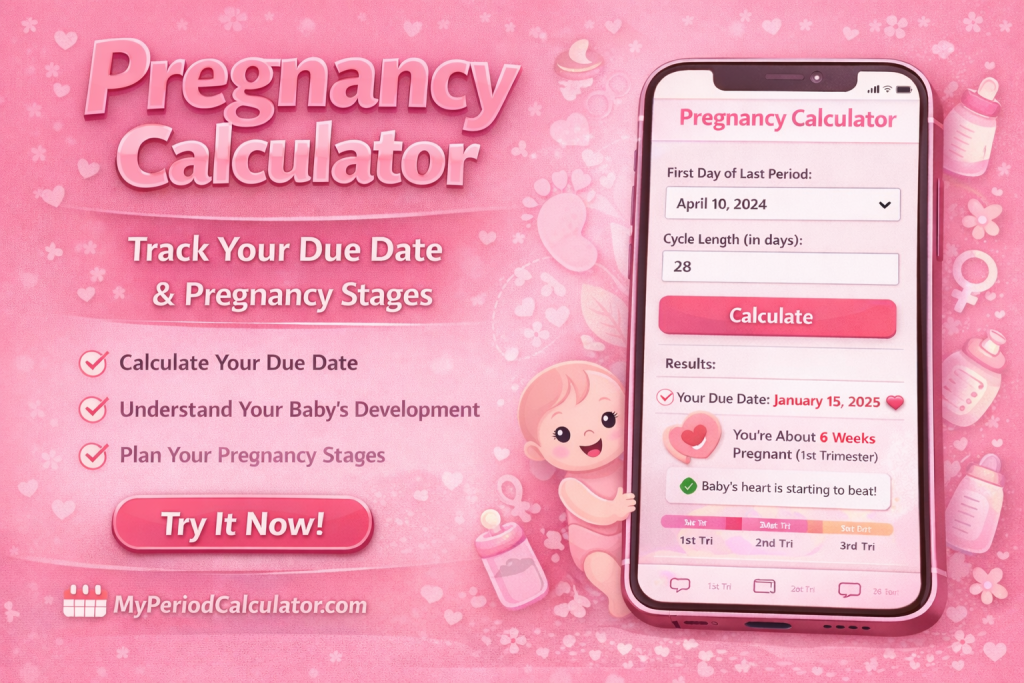
Finding out you are pregnant is one of the most exciting moments of your life. But once the initial joy settles in, the questions start coming fast. When exactly is my due date? How many weeks pregnant am I right now? What should I expect in each trimester? What is happening with my baby right now?
Our free pregnancy calculator answers all of these questions instantly. Whether you just got a positive pregnancy test this morning or you are already a few months along, enter your last period date and get a complete, personalized pregnancy timeline in seconds no sign-up, no app download, completely free.
How to Use the Pregnancy Calculator Step by Step
Using our pregnancy calculator is simple and takes less than one minute. Here is exactly what to do:
Step 1 Enter the First Day of Your Last Menstrual Period (LMP) The most common and reliable method for calculating your due date starts with the first day of your last menstrual period often written as LMP. This is the standard method used by doctors and midwives worldwide, including in the United States and India. Even though you were not actually pregnant during your last period, this date is used because it is easier to pinpoint than the exact date of conception or ovulation.
Step 2 Enter Your Average Cycle Length Most calculators assume a standard 28-day cycle, but not every woman has a 28-day cycle. If your cycle is consistently longer or shorter, entering your personal average cycle length helps the calculator adjust your ovulation date and therefore your due date estimate for greater accuracy.
Step 3 Hit Calculate Within seconds, you will receive your complete pregnancy profile, including:
- Your estimated due date (EDD)
- How many weeks pregnant you are right now
- Which trimester you are currently in
- Your conception date estimate
- A complete week-by-week pregnancy timeline
- Key milestone dates throughout your pregnancy
What Is a Pregnancy Calculator And Why Is It So Useful?
A pregnancy calculator is an online tool that uses the date of your last menstrual period to calculate your estimated due date and current stage of pregnancy. It applies the same formula used by obstetricians, gynecologists, and midwives around the world so the results you get here are directly comparable to what your doctor will tell you at your first prenatal appointment.
Beyond just giving you a due date, a good pregnancy calculator gives you context. It tells you exactly how far along you are, what is happening with your baby at this stage of development, what physical changes to expect in your own body, and when your key prenatal appointments and milestones are likely to fall.
This is especially useful in the early weeks of pregnancy, when everything feels new and uncertain. Having a clear timeline in front of you helps transform that uncertainty into excitement and preparedness.
How Is a Due Date Calculated? The Science Explained
Your estimated due date is calculated using a formula developed by a German obstetrician named Franz Naegele in the early 19th century. Known as Naegele’s Rule, this formula has been used in obstetrics for over 200 years and remains the standard method used by doctors worldwide today.
Naegele’s Rule works as follows:
Take the first day of your last menstrual period. Add 7 days. Then add 9 months. The resulting date is your estimated due date.
In simpler terms your estimated due date is approximately 280 days, or 40 weeks, from the first day of your last period.
Here is an example:
Last period started: January 1st Add 7 days: January 8th Add 9 months: October 8th Estimated due date: October 8th
It is important to understand that this is an estimate, not a guaranteed delivery date. Only about 5% of babies are born exactly on their estimated due date. The vast majority of babies about 80% are born within 2 weeks before or after the due date. A birth is considered full term anywhere between 37 and 42 weeks of pregnancy.
Your doctor may also adjust your due date based on ultrasound measurements, particularly the dating ultrasound performed in the first trimester between 8 and 14 weeks. If the ultrasound measurements suggest a different gestational age than the LMP calculation, doctors typically use the ultrasound date as it is based on actual fetal measurements rather than the assumed date of conception.
How Many Weeks Pregnant Am I?
This is one of the most common questions asked by newly pregnant women and understandably so. Pregnancy is measured in weeks, not months, which can initially feel confusing.
Pregnancy is counted from the first day of your last menstrual period, not from the date of conception. This means that by the time you actually conceive typically around Week 2 of your cycle you are already considered to be in Week 2 of pregnancy by medical standards. And by the time you get a positive pregnancy test usually around Week 4 your pregnancy is already considered 4 weeks along.
Here is a quick reference for understanding weeks of pregnancy:
Weeks 1 to 4 Very Early Pregnancy Technically, Weeks 1 and 2 are before conception even occurs. Conception typically happens around Week 2. The fertilized egg implants in the uterus around Weeks 3 to 4. Most women get their first positive pregnancy test around Week 4, shortly after the missed period.
Weeks 5 to 8 Early First Trimester By Week 5, hCG levels are high enough to cause early pregnancy symptoms in many women including nausea, breast tenderness, fatigue, and frequent urination. The embryo is tiny at this stage about the size of a sesame seed but development is happening rapidly.
Weeks 9 to 12 Late First Trimester By Week 9, the embryo officially becomes a fetus. All major organ systems have begun forming. The first prenatal appointment typically happens around this time, and the first ultrasound often occurs between Weeks 8 and 12.
Weeks 13 to 26 Second Trimester For many women, the second trimester brings relief from first trimester symptoms. Energy levels often improve, nausea subsides, and the baby bump becomes visible. The anatomy scan ultrasound which checks fetal development in detail and can reveal the baby’s sex if desired typically occurs between Weeks 18 and 22.
Weeks 27 to 40 Third Trimester The third trimester is the final stretch. The baby grows rapidly in size and weight during these weeks. Braxton Hicks contractions become more noticeable. Prenatal appointments become more frequent. Most babies are born between Weeks 37 and 42.
Your Complete Pregnancy Timeline Week by Week
Understanding what is happening with your baby and your own body at each stage of pregnancy makes the experience richer and helps you know what to expect. Here is a complete overview of your pregnancy, trimester by trimester:
First Trimester Weeks 1 to 12
Week 1 to 2 These weeks are counted from your last period. Conception has not yet occurred. Your body is preparing for ovulation, and the uterine lining is rebuilding after your last period.
Week 3 Conception occurs during this week for most women. The sperm fertilizes the egg in the fallopian tube, creating a zygote. The zygote begins dividing rapidly as it travels toward the uterus.
Week 4 The fertilized egg now called a blastocyst implants in the uterine lining. Your body begins producing hCG, the pregnancy hormone detected by pregnancy tests. You may notice a missed period. Some women experience light implantation bleeding, which is normal.
Week 5 hCG levels are rising rapidly. Early pregnancy symptoms may begin nausea, fatigue, breast tenderness, frequent urination, and heightened sense of smell are all common. The embryo is about the size of a sesame seed, but the neural tube that will become the brain and spinal cord is already forming.
Week 6 The heart begins beating — a tiny flicker that can sometimes be detected on an early ultrasound. The embryo has a recognizable head and tail end. Arm and leg buds are beginning to form.
Week 7 The embryo is about the size of a blueberry. The brain is developing rapidly. Hands and feet are taking shape, though still paddle-like at this stage.
Week 8 All major organs are beginning to form. The embryo looks increasingly human, with a distinct face forming, including eyes, nostrils, and the beginning of lips.
Week 9 The embryo officially becomes a fetus. This is a significant milestone all major body structures are now present, and the focus shifts to growth and development. The fetus is about the size of a cherry.
Week 10 The fetus can make small movements, though you cannot feel them yet. Fingers and toes are fully formed. The heart is fully divided into four chambers.
Week 11 The fetus is growing rapidly. Hair follicles are forming. The skeleton is hardening from cartilage to bone. The fetus is about the size of a fig.
Week 12 The end of the first trimester. The risk of miscarriage drops significantly after this point. Many couples choose to share their pregnancy news after Week 12. A nuchal translucency scan may be offered around this time to screen for chromosomal conditions.
Second Trimester Weeks 13 to 26
Week 13 to 16 The second trimester begins. For most women, nausea and fatigue begin to ease. The baby’s facial features are fully formed. Fine hair called lanugo begins to cover the body. The baby begins practicing breathing movements using amniotic fluid.
Week 17 to 20 The baby is growing quickly. You may begin feeling the first fetal movements often described as flutters or bubbles called quickening. This typically happens between Weeks 18 and 22 for first-time mothers, and sometimes earlier for women who have been pregnant before. The anatomy scan ultrasound is usually performed during this period.
Week 21 to 24 The baby’s hearing is developing it can begin to hear your voice and sounds from outside the womb. The skin is still translucent but is gradually becoming more opaque. The baby is now considered viable outside the womb with intensive medical support, though delivery at this stage still carries significant risks.
Week 25 to 26 The baby’s brain is developing rapidly. Eyes begin opening and closing. The baby is building fat reserves. Lung development is progressing, though the lungs are not yet mature enough for life outside the womb.
Third Trimester Weeks 27 to 40
Week 27 to 30 The third trimester begins. The baby is growing rapidly in size and weight. Brain development is accelerating. You may notice more frequent and stronger fetal movements. Braxton Hicks contractions practice contractions may become more noticeable.
Week 31 to 34 The baby is getting into position for birth most babies settle into a head-down position during this period. The lungs are maturing. The baby is gaining approximately 200 to 250 grams per week. Prenatal appointments become more frequent.
Week 35 to 37 The baby is considered late preterm. Most organ systems are fully developed. The baby is putting on the final layer of fat that will help regulate body temperature after birth. The baby is likely in a head-down position at this point.
Week 38 to 40 The baby is considered full term. Everything is ready. The baby could be born at any time. Signs of labor including regular contractions, the water breaking, or a bloody show may begin at any point during these weeks.
Pregnancy Symptoms Week by Week What to Expect
Pregnancy affects every woman differently, but there are common symptoms that many women experience at each stage. Here is what you can generally expect:
First Trimester Symptoms (Weeks 1 to 12)
Morning sickness which can actually occur at any time of day affects up to 80% of pregnant women and is caused by rising hCG levels. It typically begins around Week 6, peaks around Weeks 8 to 10, and resolves for most women by the end of the first trimester.
Extreme fatigue is one of the most commonly reported first trimester symptoms. Your body is doing an enormous amount of work in the early weeks — building the placenta, ramping up blood volume, and supporting rapid fetal development all of which is exhausting.
Breast tenderness and swelling, frequent urination, food aversions and cravings, heightened sense of smell, bloating, and light spotting from implantation are all common in the first trimester.
Second Trimester Symptoms (Weeks 13 to 26)
For most women, the second trimester brings a welcome improvement in how they feel. Energy levels typically increase, nausea subsides, and the risk of miscarriage drops significantly.
As the uterus expands, you may experience round ligament pain a sharp or cramping sensation on one or both sides of the lower abdomen, caused by the stretching of the ligaments supporting the uterus. Back pain, heartburn, nasal congestion, and visible veins are all common in the second trimester.
The most exciting second trimester milestone for most women is feeling their baby move for the first time — usually between Weeks 18 and 22.
Third Trimester Symptoms (Weeks 27 to 40)
The third trimester brings a new set of physical challenges as the baby grows larger. Heartburn and indigestion often intensify as the growing uterus pushes against the stomach. Shortness of breath occurs as the uterus presses upward against the diaphragm. Swelling of the feet and ankles, difficulty sleeping, frequent urination, and pelvic pressure are all common.
Braxton Hicks contractions sometimes called practice contractions become more frequent and noticeable in the third trimester. They are generally irregular, not intensifying over time, and do not follow a regular pattern. True labor contractions, by contrast, become progressively stronger, longer, and closer together.
Pregnancy Calculator for Indian Women What You Need to Know
In India, pregnancy care combines modern obstetrics with deep cultural traditions, and understanding both is important for a healthy pregnancy journey.
Prenatal Care in India The Ministry of Health and Family Welfare recommends a minimum of 4 antenatal care visits during pregnancy. Most Indian gynecologists recommend more frequent visits — typically monthly in the first and second trimester and every 1 to 2 weeks in the third trimester. If you are in a city, most hospitals and private clinics offer comprehensive prenatal care packages.
Iron and Folic Acid Supplementation Iron deficiency anemia is significantly more prevalent in Indian women than the global average. The Government of India recommends that all pregnant women take iron and folic acid supplements throughout pregnancy. Your doctor will typically prescribe these at your first prenatal appointment.
Diet During Pregnancy in India A balanced Indian diet can be very supportive of a healthy pregnancy. Key nutritional priorities include iron-rich foods like spinach, lentils, chickpeas, and fortified cereals; calcium from dairy products, ragi, and sesame seeds; folic acid from green leafy vegetables; and protein from dal, paneer, eggs, and legumes. Many Indian women are vegetarian, and a well-planned vegetarian diet can absolutely meet all nutritional needs during pregnancy with appropriate supplementation.
PCOS and Pregnancy in India Given the high prevalence of PCOS among Indian women, it is worth noting that women with PCOS can and do have healthy pregnancies. PCOS does carry a slightly higher risk of certain pregnancy complications including gestational diabetes and preeclampsia, which is why regular monitoring by your doctor is particularly important.
Maternity Leave in India Under the Maternity Benefit (Amendment) Act 2017, women employed in organizations with 10 or more employees are entitled to 26 weeks of paid maternity leave for the first two children. Knowing your due date allows you to plan your leave effectively.
Pregnancy Calculator for Women in the United States Key Information
Prenatal Care Schedule in the US The American College of Obstetricians and Gynecologists (ACOG) recommends the following prenatal visit schedule for uncomplicated pregnancies: monthly visits from Weeks 4 to 28, every 2 weeks from Weeks 28 to 36, and weekly visits from Week 36 until delivery. Your first prenatal appointment is typically scheduled between Weeks 8 and 10.
Key Prenatal Tests and Screenings in the US Standard prenatal care in the US includes a series of tests and screenings at various stages of pregnancy. First trimester screening including nuchal translucency ultrasound and blood tests is typically offered between Weeks 10 and 13. Cell-free DNA testing (NIPT) is available from Week 10 onward. The anatomy scan ultrasound is performed between Weeks 18 and 22. Glucose tolerance testing for gestational diabetes is typically done between Weeks 24 and 28. Group B Streptococcus (GBS) testing is done around Week 36.
Maternity Leave in the US The United States does not have a federal paid maternity leave policy, though the Family and Medical Leave Act (FMLA) provides up to 12 weeks of unpaid, job-protected leave for eligible employees. Several states including California, New York, New Jersey, Massachusetts, Connecticut, Oregon, Washington, and Colorado have their own paid family leave programs. Knowing your due date allows you to research your state’s policies and plan your leave timeline accordingly.
Health Insurance and Prenatal Care Under the Affordable Care Act (ACA), all marketplace health insurance plans are required to cover prenatal care without cost-sharing. This includes prenatal visits, screenings, and gestational diabetes testing. If you do not have insurance, Medicaid covers pregnancy-related care for women who meet income eligibility requirements, and enrollment is available at any point during pregnancy.
Choosing Your Birth Setting American women typically choose between giving birth at a hospital, a birthing center, or at home with a certified nurse-midwife. Hospital births remain the most common choice and offer access to the full range of medical interventions if needed. Birthing centers offer a more home-like environment with midwife-led care and are suitable for low-risk pregnancies. Home births are the least common option and are appropriate only for low-risk pregnancies with careful planning.
Warning Signs During Pregnancy When to Seek Immediate Help
While most pregnancies progress without serious complications, it is important to know the warning signs that require immediate medical attention. Do not wait for a scheduled appointment if you experience any of the following:
Heavy vaginal bleeding particularly in the second or third trimester is always a reason to seek immediate care.
Severe abdominal pain that is not relieved by position changes or rest requires immediate evaluation.
Sudden severe headache, especially when accompanied by visual changes, swelling of the face or hands, or high blood pressure, can be a sign of preeclampsia a serious pregnancy complication that requires prompt medical attention.
Decreased or absent fetal movement after Week 24 if you notice your baby is moving significantly less than usual, contact your doctor or go to the hospital for monitoring.
Signs of preterm labor including regular contractions before Week 37, pressure in the pelvis, lower back pain that comes and goes in a wave pattern, or a gush of fluid from the vagina require immediate medical evaluation.
High fever during pregnancy, particularly in the first trimester, requires prompt medical attention as high temperatures can affect fetal development.
Burning or pain during urination can indicate a urinary tract infection, which is more common during pregnancy and requires treatment to prevent it from spreading to the kidneys.
Frequently Asked Questions
Find answers to common questions about pregnancy calculation and tracking
| Pregnancy Calculation Questions |
|---|
|
1
How is pregnancy calculated?
Pregnancy is calculated from the first day of your last menstrual period (LMP), not from conception date.
|
|
2
How to calculate pregnancy?
Use the first day of your last period plus 280 days (40 weeks) to calculate pregnancy duration.
|
|
3
How to calculate pregnancy weeks?
Count weeks from the first day of your last menstrual period (LMP) to current date.
|
|
4
How to calculate pregnancy week by week?
Track each week from LMP date, with pregnancy typically lasting 40 weeks total.
|
|
5
How to calculate pregnancy months by weeks?
Approximately 4.3 weeks per month: 1-4 weeks = 1st month, 5-8 weeks = 2nd month, etc.
|
|
6
How to calculate pregnancy due date?
Due date = First day of last period + 280 days (or 40 weeks).
|
|
7
How to calculate due date for pregnancy?
Add 280 days (40 weeks) to the first day of your last menstrual period.
|
|
8
How do you calculate pregnancy due date?
Use Naegele’s rule: LMP + 1 year – 3 months + 7 days.
|
|
9
How can I calculate my pregnancy week?
Count weeks from first day of last period to today’s date.
|
|
10
How do I calculate my pregnancy weeks?
Subtract LMP date from current date and divide by 7 to get weeks.
|
|
11
How far along am I in my pregnancy?
Calculate weeks from LMP date: (Current date – LMP date) ÷ 7 = weeks pregnant.
|
|
12
How many weeks is pregnancy?
Full-term pregnancy is typically 40 weeks (280 days) from LMP.
|
|
13
How are pregnancy weeks calculated?
From first day of last menstrual period, each 7-day period equals one week.
|
|
14
Why is pregnancy calculated from last period?
Because most women know their LMP date but not exact conception date.
|
|
15
How to calculate pregnancy from last period?
Count days/weeks from first day of LMP to determine pregnancy duration.
|
|
16
How to calculate pregnancy from conception?
Add 266 days (38 weeks) to conception date for estimated due date.
|
|
17
How to calculate pregnancy age?
Pregnancy age is calculated in weeks from first day of LMP.
|
|
18
How to calculate weeks of pregnancy?
(Current date – LMP date) ÷ 7 = weeks of pregnancy.
|
|
19
How to calculate pregnancy after miscarriage without period?
Use conception date + 266 days or ultrasound measurements for accuracy.
|
|
20
When can I take a pregnancy test?
After missed period or 10-14 days after conception for accurate results.
|
|
21
When should I take a pregnancy test?
First morning urine after missed period gives most accurate results.
|
|
22
How soon can I take a pregnancy test?
Some tests detect pregnancy 6-8 days after ovulation/fertilization.
|
|
23
When will I get a positive pregnancy test?
Usually 10-14 days after conception when hCG levels are detectable.
|
|
24
How to calculate pregnancy by ovulation date?
Ovulation date + 266 days (38 weeks) = estimated due date.
|
|
25
How to calculate pregnancy by intercourse date?
Intercourse date + 266 days = approximate due date (if conception occurred).
|
|
26
How to calculate IVF pregnancy weeks?
Embryo transfer date + 266 days OR transfer date + embryo age in days.
|
|
27
How to calculate expected date of delivery (EDD)?
EDD = LMP + 280 days (40 weeks) OR ultrasound measurement.
|
|
28
How is trimester calculated in pregnancy?
1st trimester: weeks 1-13, 2nd trimester: weeks 14-27, 3rd trimester: weeks 28-40.
|
|
29
How to calculate pregnancy weeks into months?
Months 1-3: weeks 1-13, Months 4-6: weeks 14-27, Months 7-9: weeks 28-40.
|
|
30
How to calculate baby weight during pregnancy?
Ultrasound measurements estimate fetal weight using various formulas and measurements.
|